Golf science
Why does a golf ball curve? Club path, face angle and spin axis explained
A golf ball curves because its spin axis tilts. The tilt comes from the gap between club path and clubface at impact. Here is how start line, curve and contact fit together.
By Teeo team · Published · Last reviewed
The short answer
A golf ball curves because its spin axis is tilted.
- Why it curves
- Spin pushes the ball at a right angle to its axis. Tilt the axis and part of that push points sideways.
- Where it starts
- Mostly where the clubface points at impact.
- Which way it bends
- Toward the face and away from the path. The gap between face and club path sets the direction and the amount.
How does spin push a golf ball through the air?
Every full golf shot leaves the club with backspin. As the ball flies, the top of the ball turns with the passing air and the bottom turns against it. Air stays attached to the top a little longer and leaves the bottom sooner, so the ball throws air downward. The air pushes back, and the ball is pushed up. This is called the Magnus effect, after Heinrich Magnus, who showed in the 1850s that a spinning cylinder in a stream of air is pushed sideways.
On a drive, this push is large. It is why a well-struck drive climbs and stays in the air much longer than a ball with no spin would.
The direction of the push matters more for curve than its size. The push always acts at a right angle to two things: the line the ball spins around (its spin axis) and the direction the ball is travelling. Picture a ball flying away from you with pure backspin. Its spin axis is a horizontal line running left to right through the ball. The push points straight up, so there is lift and no sideways force.
What is the spin axis, and why does tilt make the ball curve?
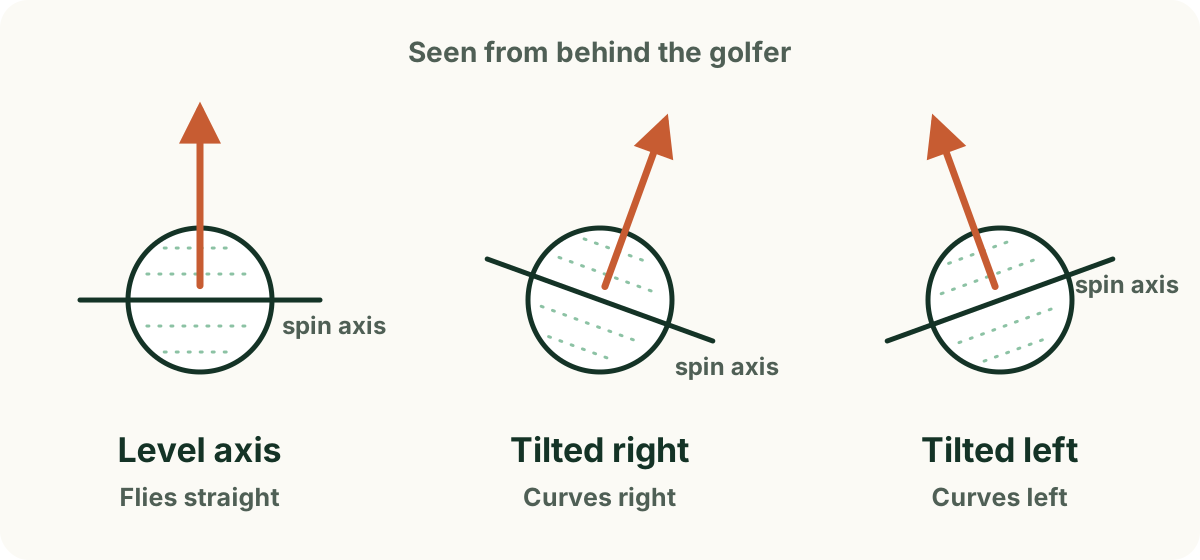
Seen from behind, the spin axis is the invisible line the ball rotates around. If that line tilts, the push tilts with it.
- Axis tilted with its right end down: the push leans right, and the ball curves right.
- Axis tilted with its left end down: the push leans left, and the ball curves left.
TrackMan reports this as a single number called spin axis. A positive value means the ball curves right and a negative value means it curves left. The axis is set at impact. Once the ball leaves the face, nothing in the swing can change it. Wind and the ball slowing down can change how much it moves, but the tilt you gave it at impact is what you play with.
How much curve does a tilt create? TrackMan gives example shots with a 10-degree spin axis: about 11 yards of curve on a 150-yard shot and about 15 yards on a 200-yard shot. Titleist's rule of thumb is about 3.5 yards of curve for every 5 degrees of tilt, per 100 yards of carry. These are guides for typical shots, not exact predictions for yours.
Does a golf ball have sidespin?
People talk about a slice as "sidespin," and some launch monitors show a backspin number and a sidespin number. A spinning ball only rotates around one axis at a time, though. "Sidespin" is a way of describing the sideways part of that one tilted spin.
Here is an example. A ball spinning 3,000 times a minute around an axis tilted 20 degrees to the right can be described as about 2,800 rpm of backspin plus about 1,000 rpm of sidespin. Those two numbers do not add up to 3,000 because they are the two sides of a right-angled triangle, and 3,000 is the long side. It is the same ball and the same spin, written two ways. TrackMan shows the second way (spin rate plus spin axis), which is why this article uses it.
What decides how much a ball curves?
Three things change the amount of curve:
| Factor | What changes it | Effect when the other two stay the same |
|---|---|---|
| Spin axis tilt | The gap between face and path, and where on the face you hit | More tilt, more of the push points sideways, more curve |
| Spin rate | Loft, club speed, contact, the ball | More spin, a stronger push, more curve for the same tilt |
| Ball speed and time in the air | Club speed, contact, launch | A faster ball that stays up longer gives the push more time to bend it |
This is one reason the driver curves more than a short iron. With a driver the ball is faster and in the air longer. Loft also matters. For the same mismatch between face and path, a more lofted club produces less tilt, so the same swing that curves a driver 20 yards may curve a 9-iron only a few.
Where does the ball start: face or path?
Before a ball can curve, it has to start somewhere. Two things at impact point in different directions:
- Face angle: where the clubface points, measured from the target line.
- Club path: the direction the clubhead is moving, measured from the target line. For a right-handed golfer, a path moving to the right of the target is called in-to-out and TrackMan gives it a positive number. A path moving to the left is out-to-in, with a negative number.
When you hit the middle of the face, the face is the bigger influence on start direction. TrackMan's rule of thumb, quoted by Titleist, is that about 85 percent of a driver's start direction comes from the face and about 15 percent from the path. For mid-irons it is closer to 75 percent face.
So if a driver face points 4 degrees right of target and the path is straight at the target, the ball starts about 3.5 degrees right. The face shoves the ball out at a right angle to its surface, and the path only drags it a little sideways along the face.
This is why the old advice "the ball starts in the direction of the swing and curves away from the face" has it the wrong way round. For a centred strike, measured club and ball data show the reverse: the ball starts mostly where the face points.
Why does the gap between face and path curve the ball?
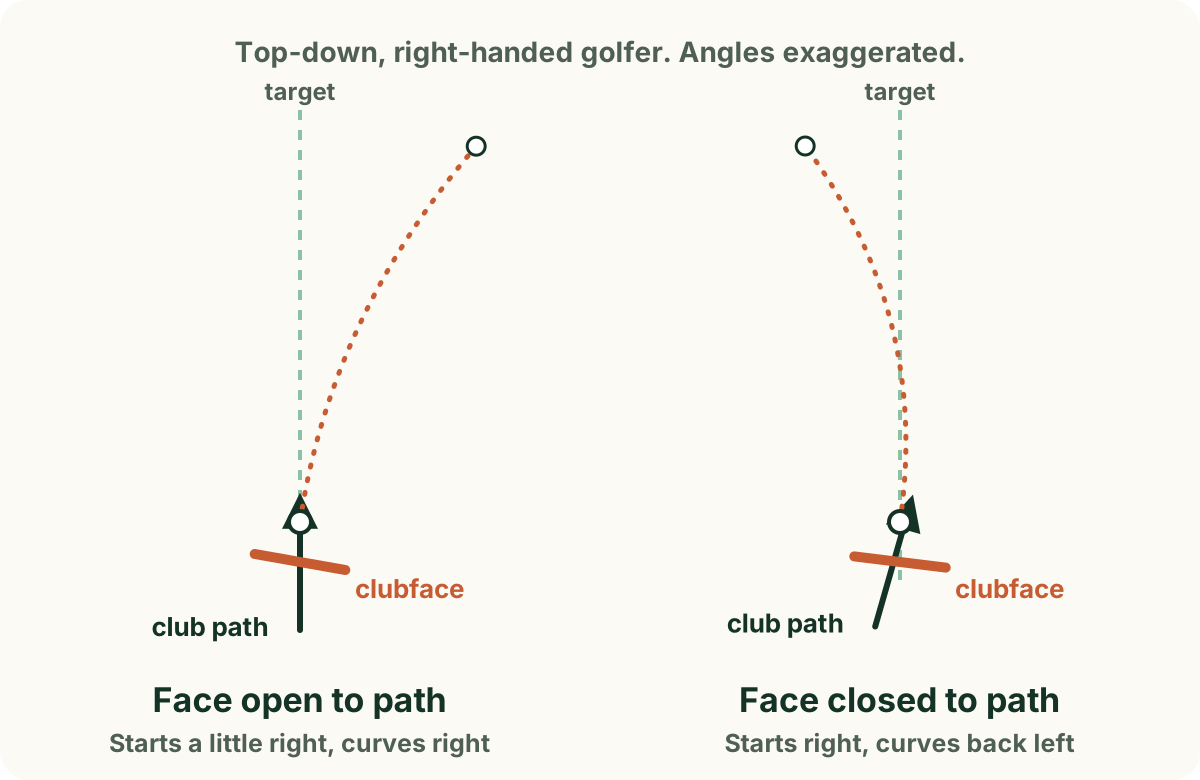
The gap between face angle and club path is called face-to-path. TrackMan measures it as face angle minus club path, which means it is measured from the path, not from the target.
- Face open to the path (positive face-to-path): the spin axis tilts right, and the ball curves right.
- Face closed to the path (negative face-to-path): the axis tilts left, and the ball curves left.
- Face square to the path (zero): the axis stays level, and the ball flies straight on whatever line it started.
Here is what happens at impact. The face is tilted back by its loft, so as it moves through the ball it drags the back of the ball downward and creates backspin. If the face points somewhere other than the path, the club is also sliding a little sideways across the face. That sideways rub tilts the spin axis. No gap, no rub, no tilt. A bigger gap gives more rub and more tilt.
TrackMan's examples for a PGA Tour drive struck in the middle of the face, carrying about 275 yards: a face 2 degrees closed to the path curves about 19 yards left, and a face 5 degrees open to the path curves about 44 yards right.
What are the nine ball flights?
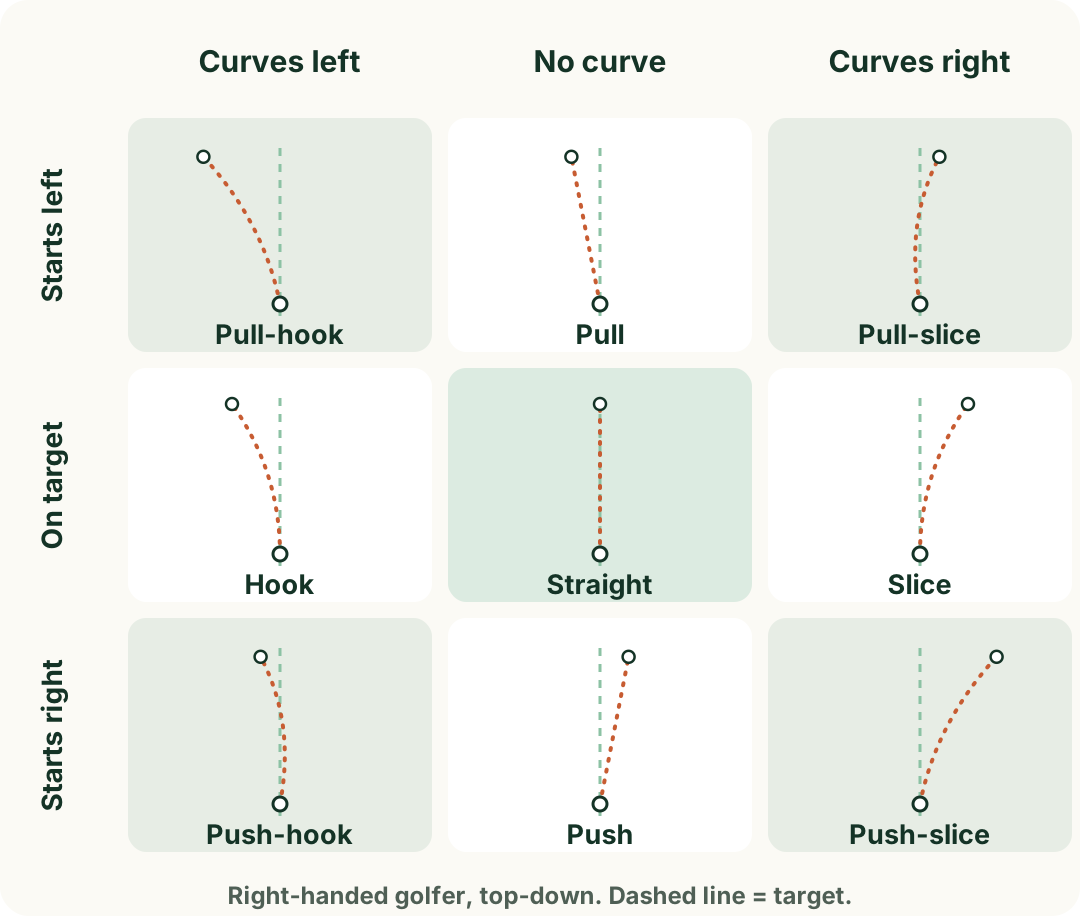
Put the two questions together. Where did the ball start (left, on target, right)? Which way did it curve (left, none, right)? That gives nine shot shapes for a right-handed golfer:
| Starts | Curves left | No curve | Curves right |
|---|---|---|---|
| Left of target | Pull-hook | Pull | Pull-slice |
| On target | Hook | Straight | Slice |
| Right of target | Push-hook | Push | Push-slice |
When the curve is gentle, golfers usually say draw (right to left) and fade (left to right) instead of hook and slice.
Read the table with face and path in mind. The start mostly tells you about the face. The curve tells you about the face relative to the path. A ball that starts left and slices right, for example, usually means the face pointed a little left of target but was still open to a path that was moving even further left.
Left-handed golfers can mirror every direction in this article.
What about shots hit off the toe or heel?
Everything above assumes you hit the middle of the face. Off-centre strikes (toe or heel), especially with a driver, add their own curve through what is called the gear effect.
A driver's centre of gravity sits deep behind the face. When you hit the ball out on the toe, the head twists open around that point, and the face rubs across the ball as it turns. Like two gears, the head turns one way and the ball spins the other. That tilts the axis left, so a toe strike tends to start right and curve left. A heel strike does the mirror image: it tends to start left and curve right.
MyGolfSpy measured about 5,700 drives from 20 golfers hitting 25 drivers and found this pattern in the averages: toe strikes started furthest right with the most left-tilted spin. In irons the effect is smaller, because the centre of gravity is closer to the face.
How can you see this in your own swing?
Without a launch monitor you cannot read face angle or club path in degrees, but you can collect useful clues.
- Watch the start line. Pick a narrow target and note whether each ball starts left, on, or right of it. That points mostly to the face.
- Watch the curve. Note whether it bends left, right or not at all. That points to face-to-path, assuming a centred strike.
- Check contact. Spray-on foot powder or a dry-erase marker on the face shows whether you hit the toe, centre or heel.
- Write down the pattern, not one shot. "Six of ten started on target and curved right" is more useful than remembering your worst one.
- Film from down-the-line and face-on so you can compare the swing with the ball flight. Our guide to recording your golf swing on iPhone covers camera position.
What this does not cover
This article explains why a ball curves. It does not tell you how to change your face or path; that depends on your grip, setup and swing, and there is more than one way to get there. If your ball flight keeps going one way and you do not know why, a coach can watch your swing and the ball together, and a coach with a launch monitor can measure face and path directly.
Wind, slope and lie also change ball flight on the course. A crosswind can make a straight shot curve or hide a real curve. Test your pattern on a calm day before drawing conclusions.
The yard figures above come from TrackMan and Titleist examples for typical shots. Your own numbers will depend on your speed, club, ball and conditions.
Common questions
Why does my ball always curve to the right?
For a right-handed golfer, a ball that curves right usually had its clubface open to the club path at impact. Heel strikes with a driver can add a right curve too. Check your contact first, then note where the ball starts, since that tells you which way the face was pointing.
Is the ball flight law "start with the path, curve with the face" wrong?
For a centred strike, yes. Launch-monitor data shows the face sets most of the start direction (about 85 percent with a driver) and the gap between face and path sets the curve. The ball curves toward the face and away from the path.
Why do I hook my driver but hit my irons straight?
The driver has less loft, so the same mismatch between face and path tilts the spin axis more. The ball is also faster and in the air longer, which gives the tilt more time to bend it. Toe strikes on a driver add left curve through the gear effect as well.
Can I hit a straight shot with an in-to-out path?
Yes, if the face is square to the path. The ball will not curve, but it will start right of the target, which golfers call a push. To finish on target from an in-to-out path, the face has to be slightly closed to the path, which is how a draw works.
Does backspin make the ball curve?
Backspin alone makes the ball climb, not curve. Curve comes from the spin axis tilting. More spin makes a tilted ball curve more, which is why high-spin shots can look more crooked.
Do I need a launch monitor to fix my curve?
No. Start line, curve direction and strike location tell you a lot. A launch monitor adds exact numbers for face, path and spin axis, which is useful when the pattern is hard to read or you work with a coach.
Start with your next recording.
Teeo is free on iPhone during the public beta, including AI swing review with one practice priority and a drill, side-by-side comparison, and session history.

Sources and further reading
- TrackMan: Spin axis
- TrackMan: Face to path
- TrackMan: Club path
- Titleist Learning Lab: Golf club face angle
- Titleist Learning Lab: Golf club path
- Titleist Learning Lab: Full-swing aim and alignment
- Titleist Learning Lab: Ball flight laws
- Titleist Learning Lab: Gear effect
- NASA Glenn Research Center: Ideal lift of a spinning ball
- Rod Cross, University of Sydney: Ball trajectories
- GolfWRX: Why you can't hit your driver as straight as your irons
- MyGolfSpy Labs: Horizontal impact location study