Range practice
Early extension: how to tell if you have it, and range drills to fix it
Early extension is when your hips move toward the ball in the downswing and your upper body stands up. Here is how to spot it on video, what can cause it, and a range plan to practice out of it.
By Teeo team · Published · Last reviewed
The short answer
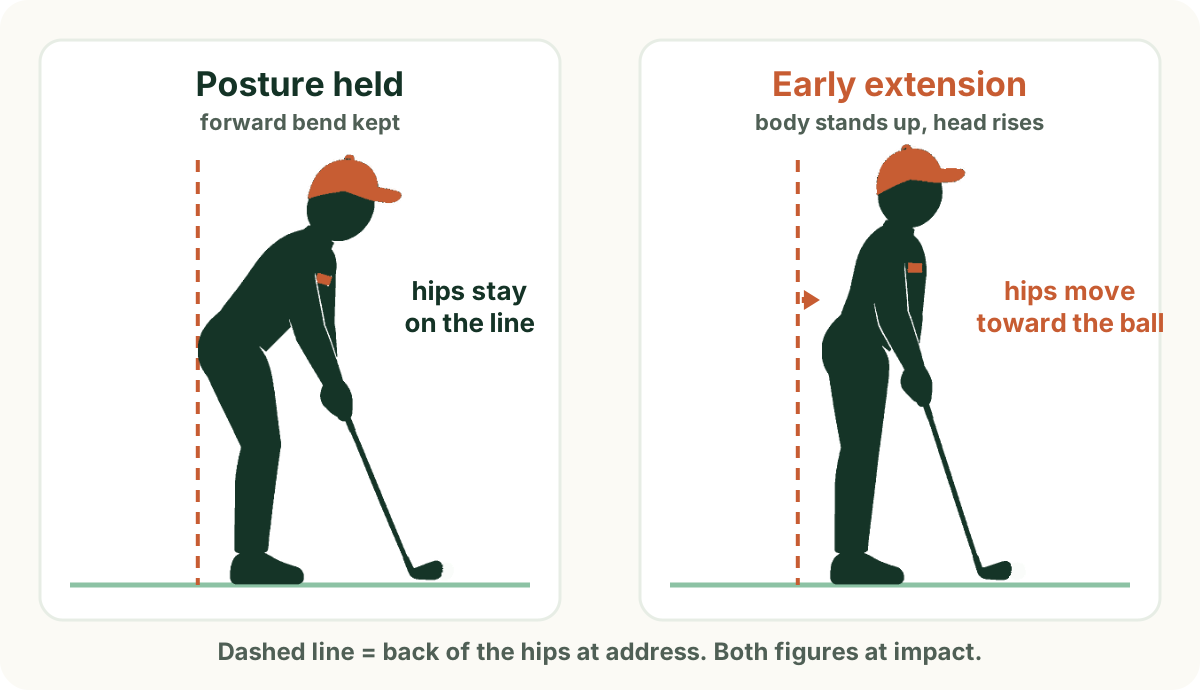
Early extension is when your hips move toward the ball in the downswing and you stand up before impact.
- How to see it
- Film from straight behind. Mark a line at the back of your hips at address. If your hips cross that line by impact, that is early extension.
- Why it matters
- It takes away the room your arms need. Blocks, pushes, hooks, thin shots and shanks can follow.
- Where to start
- Check one cause at a time: setup, mobility, or how your downswing starts. Then practice with a target behind your hips.
What is early extension?
At address, you bend forward from the hips. Your arms hang down and there is space between your body and the ball. In a good downswing, your hips turn and you keep most of that forward bend until the ball is gone.
With early extension, the hips move forward toward the ball instead. The Titleist Performance Institute (TPI) defines it as any forward movement of the pelvis toward the ball on the backswing or downswing. When the hips move forward, the upper body has to rise to make room, so your chest and head go up. Golfers sometimes call this "standing up" or "losing your posture".
The hard part is that most golfers cannot feel it. The move happens fast, and from the inside it can feel like a normal turn. That is why video is the usual way to check.
How common is it?
TPI says it has screened more than 90,000 golfers worldwide, and 67 percent of them early extend. Among the more than 100 PGA Tour, European Tour and LPGA players TPI tested, 99 percent did not.
Read those numbers in their own scope. The 67 percent comes from golfers who went through TPI's screening, not from a random sample of all golfers. The tour figure comes from about 100 players. Still, the gap tells you something useful: this is a very common fault, and it is rare among the best players.
How can you tell if you early extend?
You need one clip filmed from down-the-line: the phone straight behind you, on the line from the ball to the target, level and at about hip-to-chest height. Our guide to recording your golf swing on iPhone covers the setup. A phone at a slant can make your hips look like they moved when they did not.
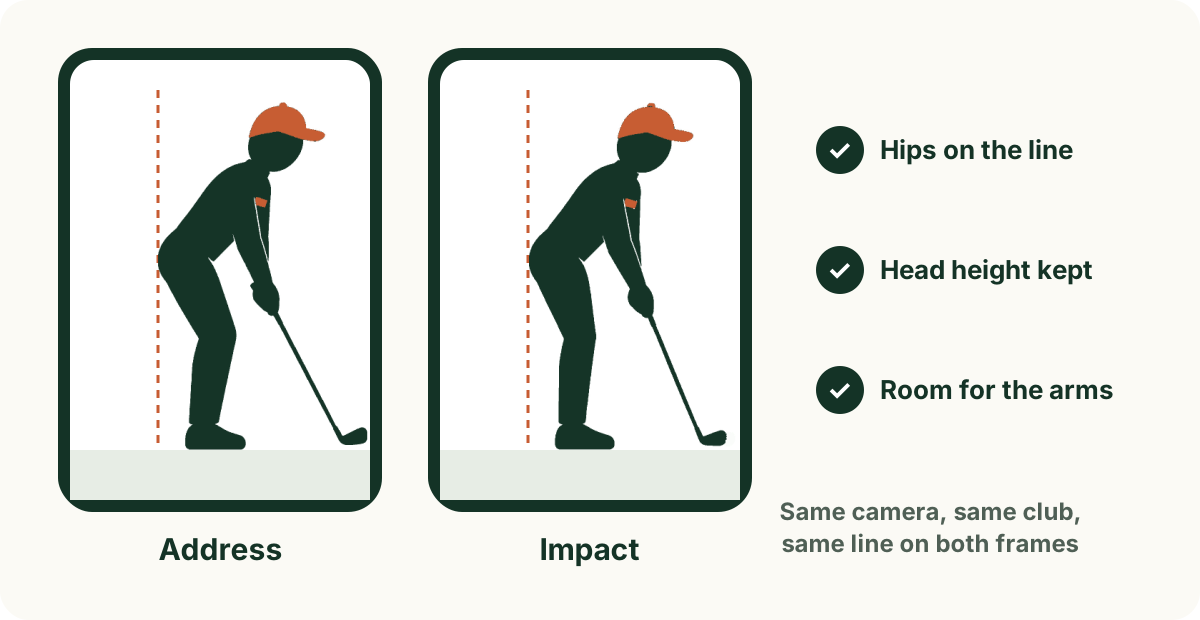
Pause the clip at address. Draw or picture a vertical line touching the back of your hips (your rear end). Then move to impact and check three signs:
- Your hips cross the line. At impact, the back of your hips has moved toward the ball, away from the line. This is the main sign.
- Your head and chest rise. Compare the top of your head at address and at impact. If it is clearly higher at impact, your upper body stood up.
- Your arms look crowded. Your hands and arms seem jammed close to your body, with no room to swing past it.
One sign on one swing is not a diagnosis. Check three to five swings with the same club. If most of them show the hips crossing the line, you have a pattern worth working on.
What does early extension do to your shots?
When your hips move toward the ball, they fill the space your arms and club need on the way down. Your body then has to save the shot with the hands and arms. TPI lists these results:
- Blocks and pushes. The ball starts well right of the target (for a right-handed golfer). If the hands then flip to square the face, a hook can follow. To see why start line and curve behave this way, read why a golf ball curves.
- Fat and thin shots, especially in the short game, because the low point of the swing moves.
- Shanks. As the body moves closer to the ball, the hosel (the neck of the club) can reach the ball before the face.
These shots can have other causes too. A push or a shank does not prove you early extend. Use the video check above before you decide.
What causes early extension?
There is rarely one cause for everyone. Coaches usually look at three areas. Find which one applies to you before you pick a drill.
| Area | What to check | Source |
|---|---|---|
| Mobility | Can you do a full deep squat, heels down, with your arms overhead? TPI names the inability to do this as a main reason golfers early extend. The squat tests the hips, knees and ankles (and the shoulders and upper back when arms are overhead). | TPI |
| How the downswing starts | If the club drops too steep or comes over the top, the hips can push forward to give the arms a way to the ball. If your weight stays on your trail foot, it is hard to turn, and the hips may thrust forward instead. | Brian Mogg, GOLF.com |
| Setup | Standing too close to the ball, or with your weight on your toes, leaves little room from the start. | Common coaching check |
GOLF.com instructor Brian Mogg puts it simply: "Early extension is often the result of another swing flaw, not the original problem." That is why drilling the symptom alone often does not last.
Range drills to fix early extension
Do these in order. Each drill checks a different cause. Use a mid-iron, such as a 7-iron, and hit easy shots. Speed comes later.
1. Setup check: give yourself room
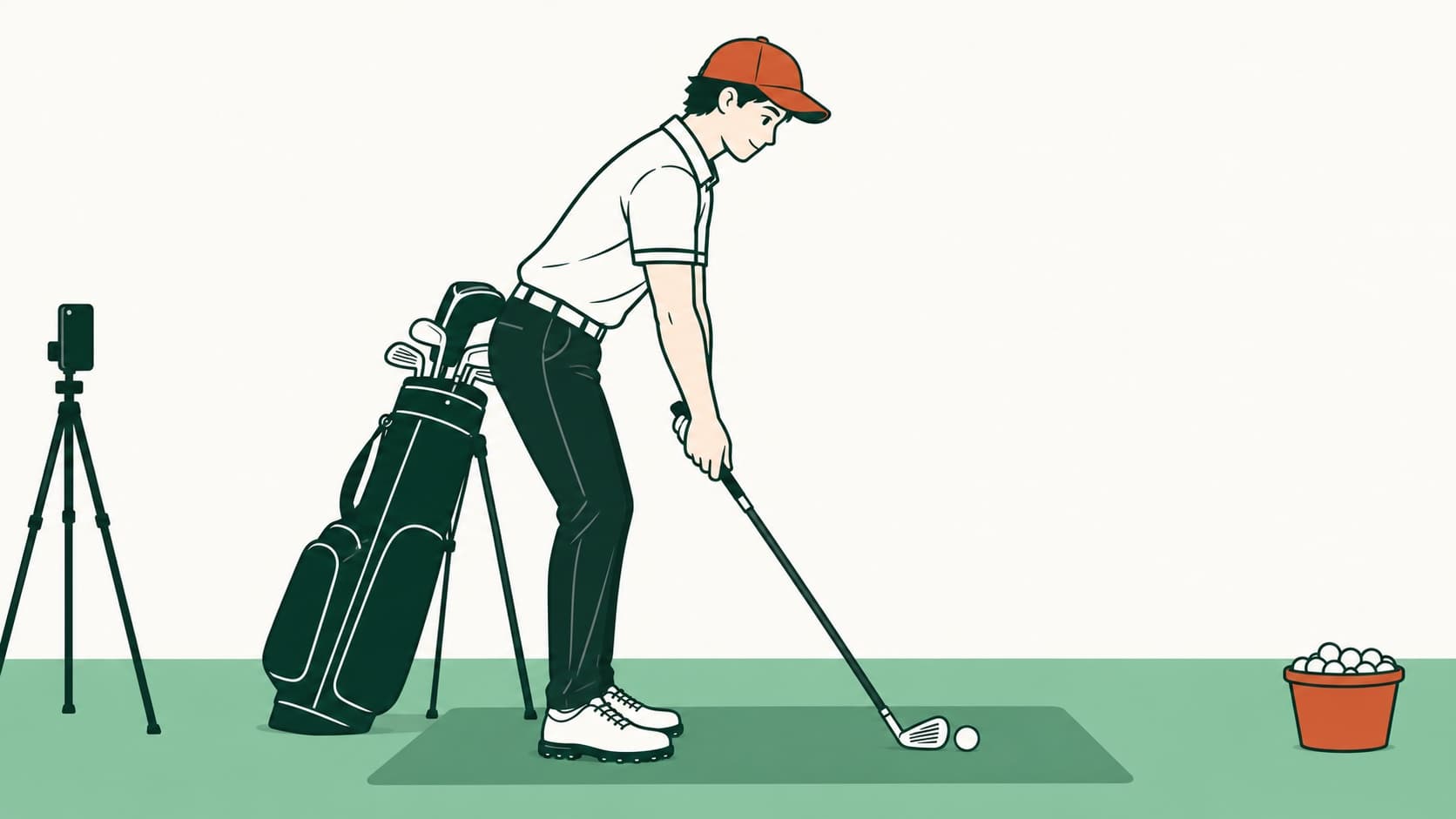
Take your address and let your arms hang straight down from your shoulders. Your hands should be roughly under your chin, not reaching out and not jammed against your thighs. Feel your weight in the middle of your feet, not on your toes. If you were standing too close, move back until your arms hang freely. Film one swing from behind to confirm.
2. Bag-behind-the-hips drill
This is the range version of the wall drill.
- Stand your golf bag on its stand just behind you, so the back of your hips lightly touches it at address. An alignment stick pushed upright into the bag's stand works too.
- Make a slow practice swing first to check the club clears the bag.
- Make half swings. Keep the back of your hips touching the bag through impact. In the downswing, the lead side of your hips (the left side for a right-handed golfer) should stay in contact as you turn.
- After 5 to 10 half swings with contact, hit 5 balls without the bag and film them.
If you cannot keep contact even in slow motion, mobility may be the limit. Go back to the squat check in the causes table.
3. Pressure shift drill
This one works on the downswing cause from Brian Mogg's list. At the top of the backswing, feel pressure in the inside of your trail foot. Start the downswing by moving pressure to your lead foot before your arms swing down. Make slow half swings and hold your finish on the lead foot for two seconds. If you fall back onto your trail foot, the pressure did not move.
4. Off the range: the deep squat test
At home, stand with your feet shoulder-width apart, hold a club over your head with straight arms, and squat as low as you can with your heels on the floor. If you cannot reach a deep squat, practice slowly and within comfort, and consider a TPI-certified professional or a physiotherapist. Stop if anything hurts.
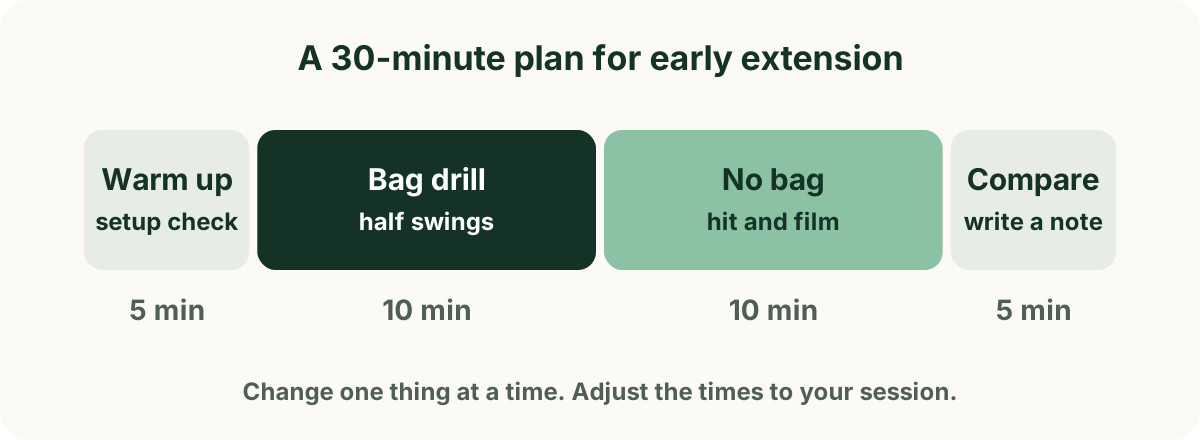
A 30-minute range plan
| Time | What to do | What to check |
|---|---|---|
| First 5 minutes | Warm up with easy swings. Do the setup check and film one swing from behind. | Arms hang freely. Weight in the middle of the feet. |
| Next 10 minutes | Bag-behind-the-hips drill, half swings, then a few balls. Add the pressure shift if your weight stays back. | The back of your hips stays on the bag through impact. |
| Then 10 minutes | Remove the bag. Hit normal shots at a target and film 3 to 5 of them. | Hips stay near the address line. Contact and start line. |
| Last 5 minutes | Compare one clip from today with your first clip. Write a short note. | Did the hips cross the line less often? |
Change one thing at a time. If the setup check fixed most of it, stay with that for the session. For a general structure, see how to practice at the driving range with a clear plan.
How do you know it is getting better?
Compare clips, not feelings. Put a clip from your first session next to a new one, both from the same camera position and with the same club. Pause both at address and at impact, and check the hip line.
Film again after a week of practice and compare. Expect slow progress. A change you can hold in half swings often comes back under full speed at first. That is normal.
What this does not cover
This article explains how to spot early extension and gives a starting set of drills. It does not replace a lesson. If the hips keep crossing the line after a few weeks, or you are not sure which cause applies to you, a coach can watch your swing in person and find the root cause faster.
If you have back, hip or knee pain, see a medical professional before you work on mobility or change your posture. Some golfers move toward the ball because of a physical limit, and forcing a position can hurt.
The TPI figures describe the golfers TPI tested, not all golfers. This article uses a right-handed golfer in all examples; reverse left and right if you play left-handed.
Common questions
What is early extension in golf, in simple terms?
Your hips move toward the ball during the downswing, and your upper body stands up before impact. You lose the forward bend you had at address.
Can early extension cause a slice?
It is more often linked to blocks, pushes, hooks, thin shots and shanks. Some golfers who come over the top also early extend, so the two can appear together. Check your start line and curve, and see why a golf ball curves for what each pattern means.
Is the wall drill enough to fix early extension?
It helps you feel where your hips should be. It does not fix the reason they move. If the cause is your setup, mobility or a steep downswing, work on that too.
How long does it take to fix early extension?
It depends on the cause. A setup fix can change things in one session. A mobility limit or a long-time movement pattern can take weeks. Film every week or two and compare.
Do I need a launch monitor to check for early extension?
No. A phone filming from straight behind is enough to see the hips cross the address line. A launch monitor measures the ball and club, not your hip movement.
Why do I early extend more with the driver?
You swing faster with a driver, and many golfers try to hit harder with it. Extra effort often shows up as the hips thrusting toward the ball. Practice the drills with a mid-iron first, then move to the driver.
Start with your next recording.
Teeo is free on iPhone during the public beta, including AI swing review with one practice priority and a drill, side-by-side comparison, and session history.